
Thought For The Day – Thursday 4th June 2026
Community
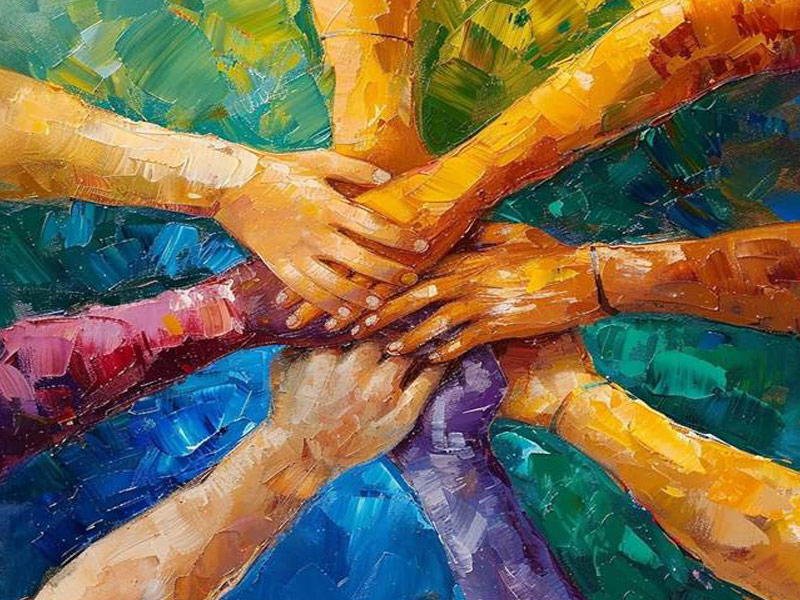
In our world, we celebrate, and understand, enlightening, enriching, and respectful diversity.
Our unity, our community, comes from embracing appropriate and wonderful difference, seeking to learn, listen and love, not dictate and impose.
We all need each other. We all care for each other. We lift each other up.
We show respect and take responsibility. For others. For ourselves.
The canvas of community is beautiful, bright, multicoloured, and vivid.
Over the holidays two important cultural, and religious, festivals were celebrated.
On Sunday the 24th of May, Christians celebrated Pentecost.
Originating from the Greek word “pentekoste”, meaning “fiftieth”, Christians believe Pentecost marks the giving of the Holy Spirit to the Disciples and Apostles and other followers of Jesus Christ fifty days after Easter Sunday. This proceeded from Jesus’ Ascension to Heaven forty days after Easter Sunday. We learnt about the meaning of Easter at our services at Saint Michael’s Church in Bishop’s Stortford.
Christians believe, this gift of the Holy Spirit empowered, and empowers, them to spread the “Gospel” or Good News of God and Jesus Christ. For Christians, the Holy Spirit is God’s profound light, that guides them in their lives as they spread love.
Love was, and is, also shown in other cultures, communities, and religions.
Love was and is shown in Islam as, from the evening of Tuesday the 26th of May to the evening of Friday 29th of May, Muslims celebrated Eid al-Adha. This important occasion marked the close of the annual pilgrimage to Makkah in Saudi Arabia.
When engaging on this holy journey, which replicates the journey of Prophet Muhammad (Peace Be Upon Him), Muslims: wear white, to symbolise equality; visit The Ka’aba, the oldest mosque, in which direction Muslims pray a number of times every day; and visit places nearby such as Arafat and Mina, where Muslims humbly pray for forgiveness, thinking about life after death, and, at Mina, throwing small stones at pillars, representing the rejection of evil, before returning to The Ka’aba.
If Muslims experience this pilgrimage at a certain time of year, it is called the Hajj. If Muslims experience the pilgrimage at another time of year, it is called the Umrah.
Islam is a religion of compassion and understanding. Muslims can only engage on this lifetime spiritual journey if they are healthy and are able to do so.
At the end of the Hajj, Eid al-Adha also remembers Prophet Ibrahim (Abraham), a “friend of God” according to the Qur’an, who stood up for Allah, The One God, Muslims believe. The word Islam means peace through putting God first.
Muslims mark Eid al-Adha by: praying and giving thanks to Allah; reading the Qur’an, the Word of God in Islam; visiting the mosque; taking time away from work and school; giving charity to those in need; exchanging cards and gifts; and visiting the graves of loved ones who have passed away.
Muslims also have special community meals. Thanks, as always, for their beautiful Eid al-Adha meal yesterday to: Mrs. Miles; Mr. Cooper and and the catering team.
A guide to Hajj: https://www.bbc.co.uk/programmes/p02mwk0y